
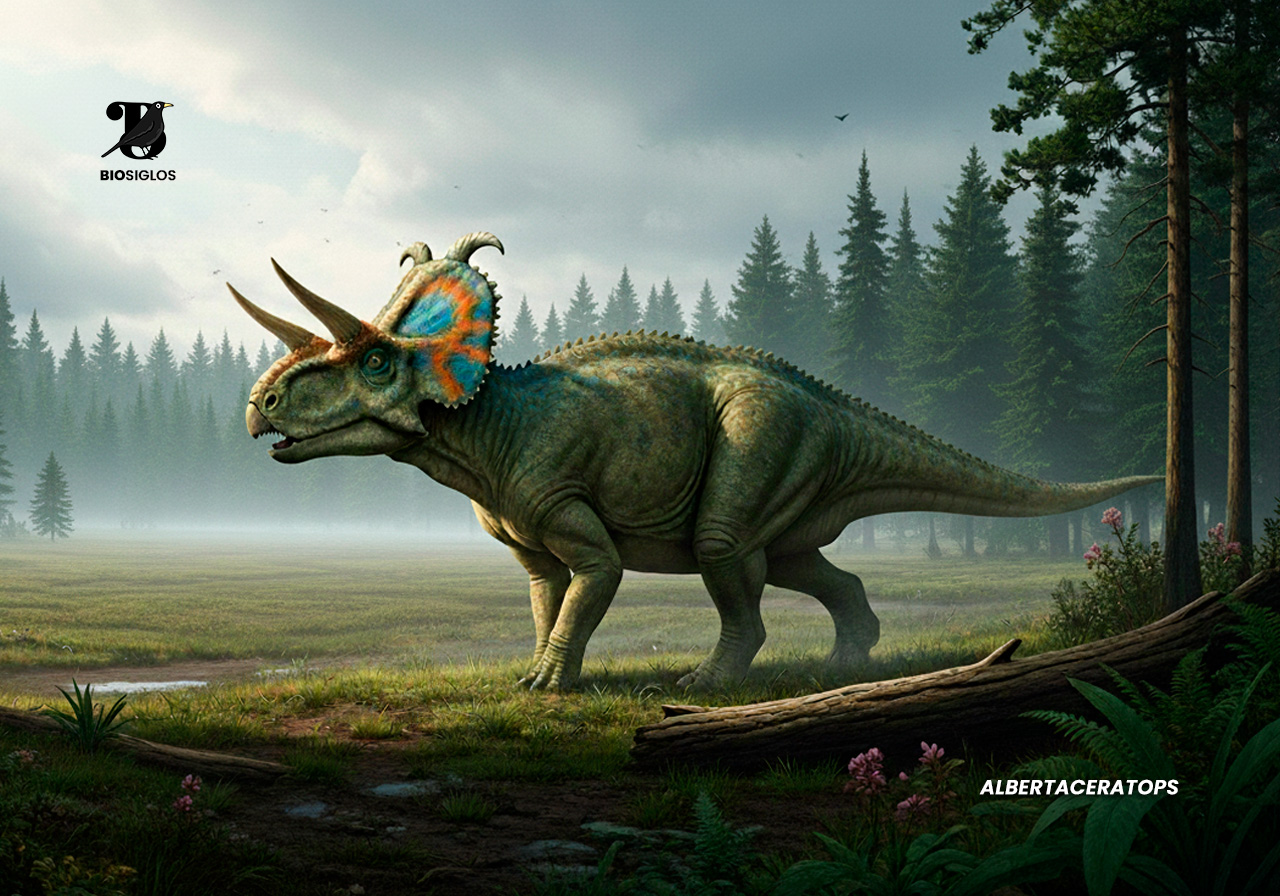
Albertaceratops
Albertaceratops was a ceratopsian dinosaur that lived during the Late Cretaceous in what is now Canada. It had a unique mixture of traits that helps to understand the evolution of horned dinosaurs.
🦕 Basic Info
- Scientific and common name: Albertaceratops nesmoi – Albertaceratops
- Meaning of the name: “Horned face from Alberta”
- Geological epoch or period: Late Cretaceous (~77 million years ago)
- Location of discovery: Alberta, Canada (Oldman Formation)
- Classification:
- Kingdom: Animalia
- Phylum: Chordata
- Class: Reptilia
- Order: Ornithischia
- Family: Ceratopsidae
- Genus: Albertaceratops
- Diet: Herbivore
🧪 Main Characteristics
- Size: A medium-sized ceratopsian, with a length of 5 to 6 meters and a weight of about 2 tons.
- Horns over the eyes: Its most notable feature was two extremely long horns over its eyes, similar to those of a bull. This is a typical characteristic of chasmosaurines, like Triceratops.
- Nasal horn and frill: Despite its long brow horns, it had a bony boss on its nose and a short frill with small spikes, which are distinctive features of centrosaurines.
- Unique combination: It is the only known ceratopsian that combines long brow horns with the anatomy of a centrosaurine, which initially caused much confusion for paleontologists.
- Beak: It had a sharp beak for cutting fibrous plants, which it then crushed with its complex dental batteries.
🌍 Environment in which it lived
- Habitat: A lush, low-lying, and swampy coastal plain, with numerous rivers and estuaries that flowed into the Western Interior Seaway.
- Climate: The climate was subtropical, warm, and humid, with abundant rainfall.
- Ecosystem: It was part of the diverse fauna of the Oldman Formation. It was one of the main large herbivores in its environment.
- Vegetation: It fed on the rich flora of its environment, which included ferns, cycads, and the first flowering plants.
🧬 Evolutionary Transition
- Role: It is the oldest known centrosaurine, providing a glimpse into the ancestral anatomy of this group.
- Relationship: Despite its horns, it is a basal member of the Centrosaurinae. Its closest relative is Medusaceratops.
- Mosaic evolution: It is a perfect example of mosaic evolution, where an animal presents a mixture of primitive and advanced traits. It demonstrates that the evolution of horns and frills in ceratopsians was not a simple linear progression.
- Importance: Its discovery in 2001 forced scientists to re-evaluate the definitions of the two major subgroups of ceratopsians, demonstrating that the evolution of long brow horns occurred independently in both lineages.
🦴 Fossils Found
- Material: It is known from a single complete skull and several skull fragments from a bone bed.
- Discovery: The main skull was discovered in Alberta, Canada, in 2001. The bone bed was found in Montana.
- Condition: The holotype skull is exceptionally well-preserved, which has allowed for a detailed study of its unusual combination of features.
- Relevance: It is a reference fossil for paleontology, as its discovery challenged established ideas and opened new avenues of research into the evolution of ceratopsians.
👪 Relationship with other species
- Dinosaurs: It coexisted with the tyrannosaurid predators Daspletosaurus and Gorgosaurus, and with herbivores like the hadrosaurs Brachylophosaurus, Parasaurolophus, Corythosaurus, and Gryposaurus.
- Reptiles: It shared the rivers and swamps with the crocodile Leidyosuchus and the aquatic reptile Champsosaurus.
- Amphibians: Salamanders like Scapherpeton and frogs were common in the aquatic environments.
- Fish: The waters were filled with fish like the gar (Lepisosteus) and the freshwater ray (Myledaphus).
- Mammals: It lived alongside small mammals like the primitive marsupial Eodelphis and the multituberculate Cimolomys.
- Birds: Primitive birds could be seen in the skies. Pterosaurs (flying reptiles) were also a component of the fauna.