
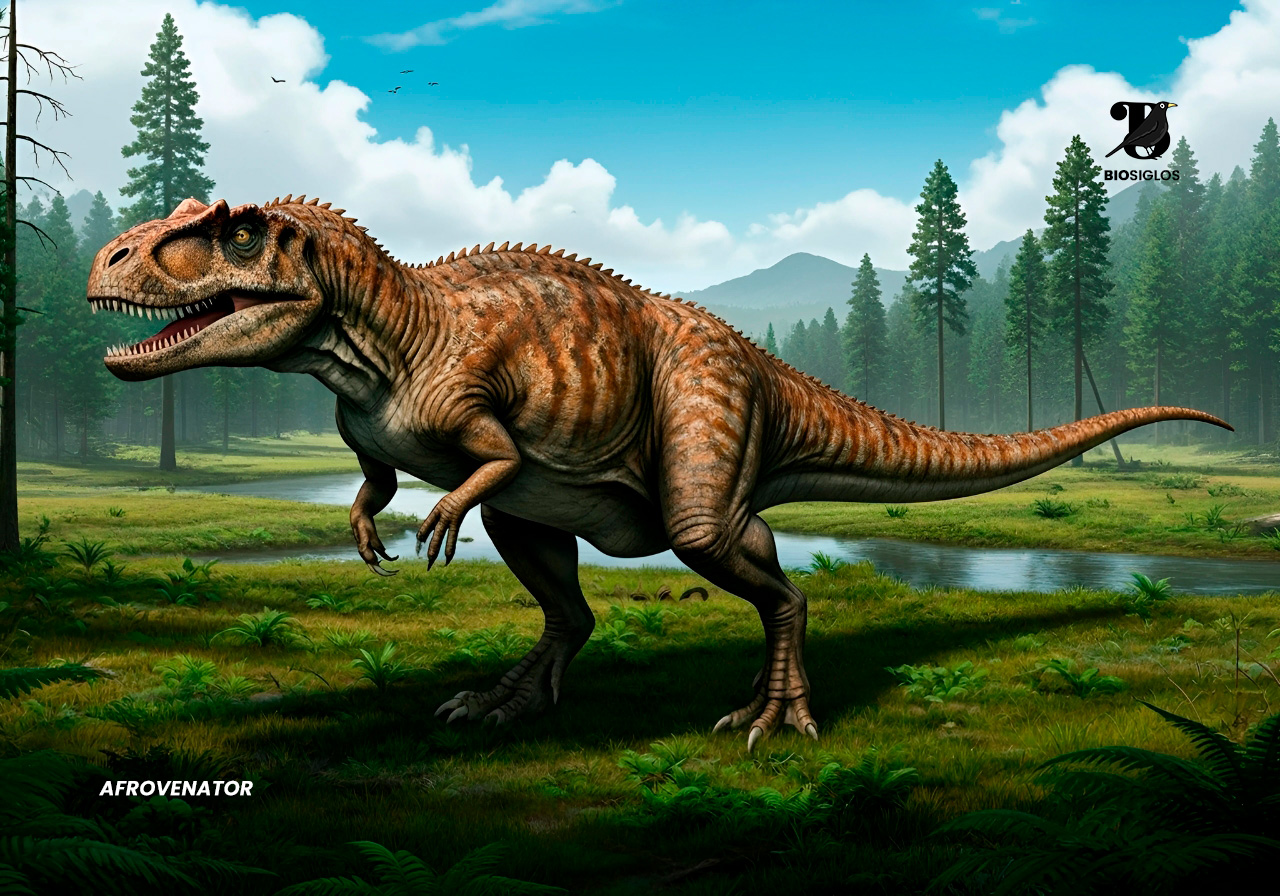
Afrovenator
Afrovenator was a carnivorous theropod dinosaur that lived during the Middle Jurassic period in what is now North Africa. Its discovery helped to complete the knowledge about the predators of Gondwana.
🦕 Basic Info
- Scientific name: Afrovenator abakensis
- Common name: Afrovenator
- Meaning of the name: “African hunter”
- Period: Middle Jurassic (~167 million years ago)
- Location of discovery: Niger, Africa (Tiouraren Formation)
- Classification:
- Kingdom: Animalia
- Phylum: Chordata
- Class: Reptilia
- Order: Saurischia
- Family: Megalosauridae
- Genus: Afrovenator
- Diet: Carnivore
🧪 Main Characteristics
- Size: approximately 7–8 meters long
- Weight: between 1 and 1.5 tons
- Locomotion: bipedal
- Skull: elongated with powerful jaws and curved, serrated teeth
- Arms: relatively long, with three fingers with sharp claws
- Body structure: slender and muscular, built for speed
- Adaptations: great agility, suitable for ambushing or chasing medium-sized prey
🌍 Environment in which it lived
- Habitat: A river plain with rivers and abundant vegetation of conifers and ferns.
- Climate: The climate was seasonal, with dry and wet periods.
- Ecosystem: It was the apex predator of its ecosystem in ancient Jurassic Africa, hunting the large herbivores with which it coexisted.
- Prey: Its main prey was likely the primitive sauropod Jobaria.
🧬 Evolutionary Transition
- Role: It represents one of the most complete and best-known forms of the Megalosauridae family.
- Relationship: It is a close relative of other Jurassic predators like Megalosaurus and Torvosaurus. Its discovery helped confirm that this group of predators had a global distribution.
- Importance: It is one of the few well-known predatory dinosaurs from the Jurassic of Africa, a continent and a period with a relatively sparse theropod fossil record.
- Biogeography: Its relationship with European and North American forms suggests that the continents were still connected during the Middle Jurassic, allowing for the exchange of faunas.
🦴 Fossils Found
- Material: It is known from a single skeleton, but it is remarkably complete and includes most of the skull, spine, pelvis, and limbs.
- Discovery: It was discovered in the Sahara Desert, in Niger, in 1993, by an expedition led by paleontologist Paul Sereno.
- Condition: The skeleton is very well-preserved, which makes it one of the most complete Jurassic theropods from Gondwana.
- Relevance: It is a reference fossil for African paleontology and has been fundamental in defining the Megalosauridae family and understanding the evolution of large theropods.
👪 Relationship with other species
- Dinosaurs: It coexisted with and hunted the primitive sauropod Jobaria, and shared its habitat with the sauropod Spinophorosaurus.
- Reptiles: It shared its habitat with primitive crocodiles and various species of turtles.
- Amphibians: Temnospondyl amphibians inhabited the aquatic environments.
- Fish: The river systems were populated by bony fish and lungfish such as Ceratodus.
- Mammals: Mammals were very scarce and small in size.
- Birds: True birds did not exist, but the skies were dominated by pterosaurs (flying reptiles).