
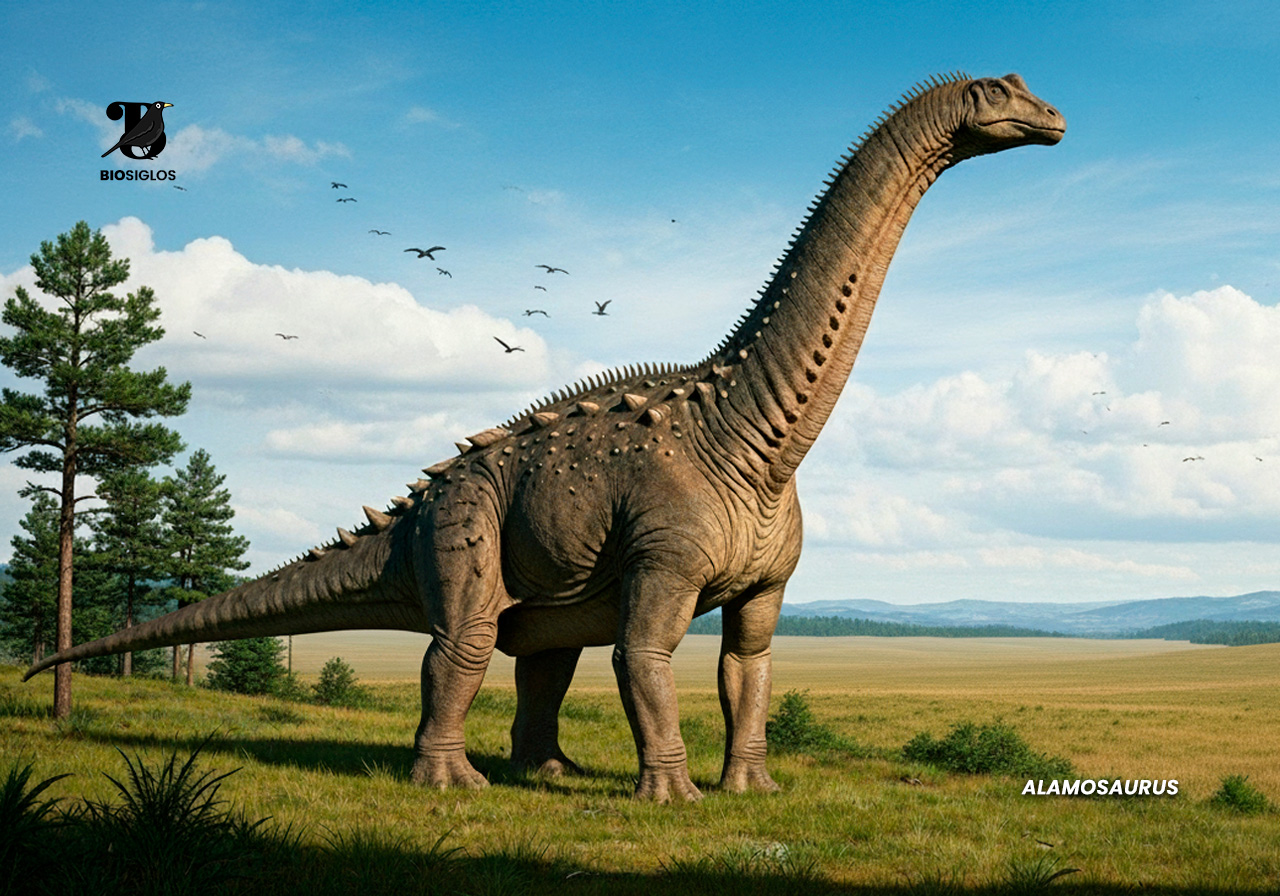
Alamosaurus
Alamosaurus was one of the last great sauropods to inhabit North America, just before the Cretaceous mass extinction. It is a key figure for understanding the ecological changes at the end of the age of dinosaurs.
🦕 Basic Info
- Scientific and common name: Alamosaurus sanjuanensis – Alamosaurus
- Meaning of the name: “Ojo Alamo Lizard” (after the Ojo Alamo geologic formation, not the Alamo fort)
- Geological epoch or period: Late Cretaceous (~70 to 66 million years ago)
- Location of discovery: Southwestern United States (Texas, New Mexico, Utah)
- Classification:
- Kingdom: Animalia
- Phylum: Chordata
- Class: Reptilia
- Order: Saurischia
- Family: Saltasauridae
- Genus: Alamosaurus
- Diet: Herbivore
🧪 Main Characteristics
- Size: A colossal giant, with length estimates of 28 to 30 meters and a weight of 70 to 80 tons, rivaling the largest titanosaurs of South America.
- Neck and tail: It had an extremely long neck that allowed it to reach the highest foliage, and a long tail that acted as a counterbalance.
- Armor: Like many titanosaurs, it is very likely that it had osteoderms (bony plates) embedded in its skin, which provided armor against predators.
- Body: A very robust and massive build, with columnar legs to support its immense weight.
- Posture: It had a “wide-gauge” posture, with its legs set far apart from the body, which gave it great stability.
🌍 Environment in which it lived
- Habitat: A floodplain with a system of rivers and forests.
- Climate: The climate was warm and semi-arid, with well-marked seasons.
- Ecosystem: It was the dominant herbivore of its ecosystem in southern North America. Its immense size in adulthood made it practically immune to attacks from Tyrannosaurus rex.
- Vegetation: It fed on enormous quantities of vegetation, mainly from the tops of trees like conifers.
🧬 Evolutionary Transition
- Role: It represents a successful invasion of South American titanosaurs into North America at the end of the Cretaceous.
- Relationship: It is an advanced member of the Saltasauridae family, closely related to titanosaurs from South America like Neuquensaurus and Saltasaurus.
- Biogeography: Its presence in North America is crucial proof of the existence of a land bridge (the Isthmus of Panama) that connected both continents at the end of the age of dinosaurs, allowing this migration.
- Survivor: It was one of the last sauropod genera to exist, living right up to the Cretaceous-Paleogene mass extinction event.
🦴 Fossils Found
- Material: It is known from numerous remains, although most are fragmentary. However, recent discoveries of more complete specimens have allowed for estimating its colossal size.
- Discovery: The first bones were discovered in 1921 by paleontologist Charles W. Gilmore.
- Condition: For a long time, it was thought to be a medium-sized sauropod, until the discovery of gigantic vertebrae and limb bones in the 21st century revealed its true nature as one of the largest dinosaurs.
- Relevance: It is a key fossil for understanding dinosaur migrations between the American continents and the composition of the last ecosystems of the Mesozoic.
👪 Relationship with other species
- Dinosaurs: It coexisted with the super-predator Tyrannosaurus rex and Dryptosaurus, as well as the ceratopsids Torosaurus, Triceratops, and Bravoceratops. It also shared its habitat with ankylosaurs like Nodocephalosaurus, and with ornithopods like Edmontosaurus.
- Reptiles: It shared the rivers and swamps with the giant crocodile Deinosuchus and turtles like Adocus.
- Amphibians: Aquatic environments were inhabited by amphibians such as frogs and salamanders.
- Fish: The river systems were populated by fish like the gar (Lepisosteus) and the freshwater ray (Myledaphus).
- Mammals: It lived alongside a great diversity of mammals, such as the marsupial Didelphodon and the multituberculate Mesodma.
- Birds: Primitive birds could be seen in the skies, along with the largest pterosaur (flying reptile) of all time, Quetzalcoatlus.