
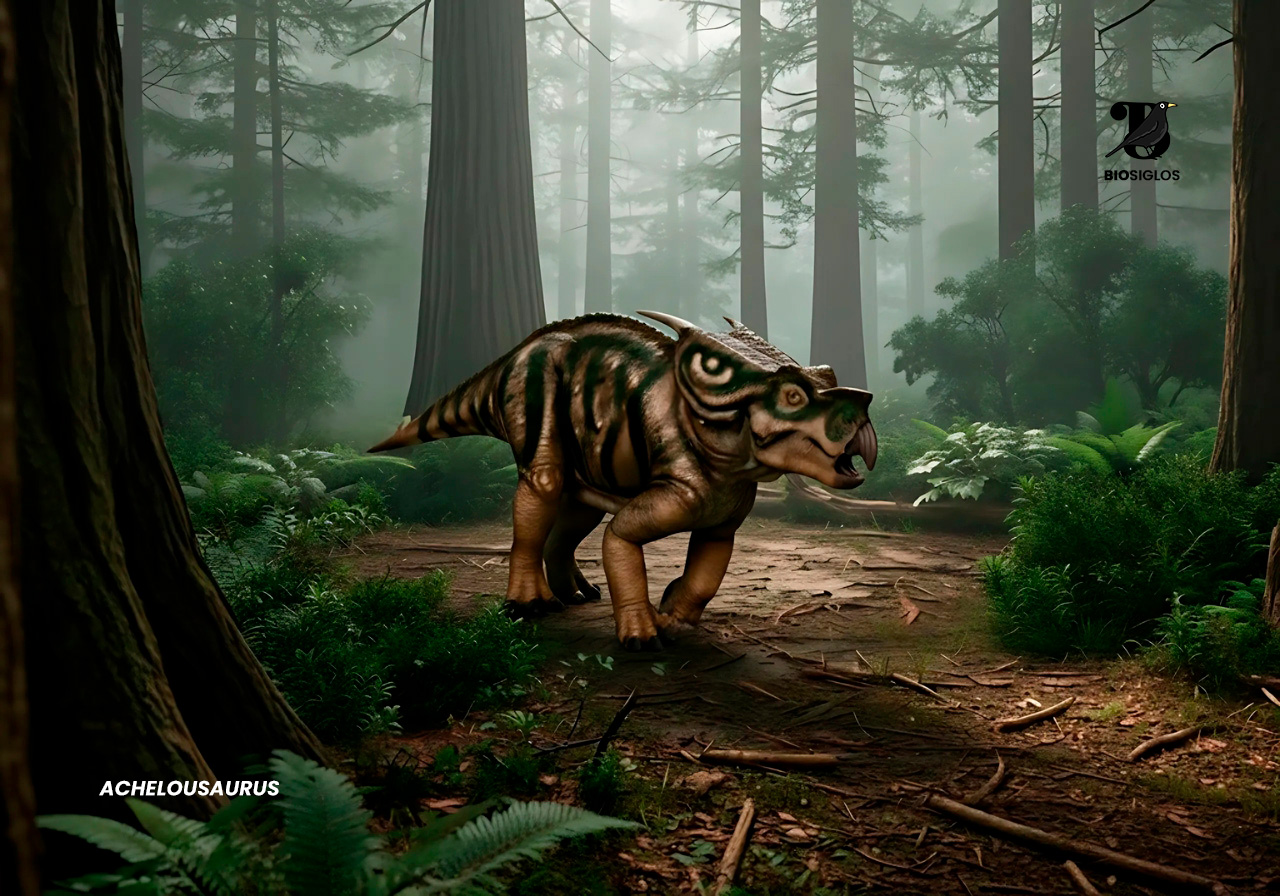
Achelousaurus
Achelousaurus was a ceratopsian dinosaur from the Late Cretaceous. Its main characteristic is a prominent bony boss instead of a nasal horn, which suggests an evolutionary transition stage within the centrosaurines.
🦕 Basic Info
- Scientific name: Achelousaurus horneri
- Common name: Achelousaurus
- Meaning of the name: “Achelous’ lizard” (in reference to the Greek god Achelous, who lost his horns fighting Hercules)
- Period: Late Cretaceous (~74 million years ago)
- Location of discovery: United States (Montana, Two Medicine Formation)
- Classification:
- Kingdom: Animalia
- Phylum: Chordata
- Class: Reptilia
- Order: Ornithischia
- Family: Ceratopsidae
- Genus: Achelousaurus
- Diet: Herbivore
🧪 Main Characteristics
- Size: ~19 feet long
- Weight: around 3 tons
- Locomotion: quadrupedal
- Skull: massive, with a large bony frill on its neck
- Face: it lacked a pointed nasal horn; instead, it had a rough bony boss
- Dentition: dental batteries adapted for cutting fibrous plants
- Horns: small horns over the eyes and complex ornamentation on the neck frill
🌍 Environment in which it lived
- Habitat: A coastal plain with a seasonal climate, alternating between warm, dry periods and rainy seasons. It shared its habitat with other ceratopsians, hadrosaurs, and predators like Daspletosaurus.
- Climate: The climate was semi-arid, with seasonal variations in temperature and precipitation.
- Ecosystem: It was part of the rich fauna of the Two Medicine Formation. It lived in large herds to protect itself from predators.
- Vegetation: It fed on low-growing vegetation, such as ferns and the first flowering plants.
🧬 Evolutionary Transition
- Role: It is a key transitional fossil that documents macroevolution in horned dinosaurs.
- Anagenesis: It is considered the intermediate form in a single evolutionary lineage (anagenesis) that began with Rubeosaurus, passed through Einiosaurus (with its curved horn), transformed into Achelousaurus (with the nasal boss), and culminated in Pachyrhinosaurus (with an even larger boss).
- Importance: This sequence, documented in the rock layers of Montana, is one of the clearest demonstrations of the evolution of one species into another over geological time.
- Function of the boss: The transition from a horn to a boss suggests a change in combat behavior, moving from display or stabbing to pushing and head-butting contests.
🦴 Fossils Found
- Material: It is known from the remains of several individuals, including three skulls from different growth stages.
- Discovery: It was discovered by paleontologist Jack Horner in the 1980s in Montana.
- Condition: The skulls are well-preserved and have been crucial in establishing its position as a transitional form between Einiosaurus and Pachyrhinosaurus.
- Relevance: It is a world-famous fossil and a textbook example of how large-scale evolution works in the fossil record.
👪 Relationship with other dinosaurs
- Dinosaurs: It coexisted with hadrosaurids like Hypacrosaurus and Maiasaura, the tyrannosaurid predator Daspletosaurus, and the small “raptor” Bambiraptor. It belongs to the same group as Centrosaurus and Styracosaurus.
- Reptiles: It shared its habitat with crocodiles, turtles like Basilemys, and the aquatic champsosaur Champsosaurus.
- Amphibians: Salamanders, frogs like Scotiophryne, and other amphibians were common in the numerous bodies of water of the formation.
- Fish: The rivers and lakes were populated by a variety of bony fish, including gars like Lepisosteus and sturgeons.
- Mammals: It lived alongside small mammals, such as the multituberculate Cimexomys and the primitive marsupial Alphadon.
- Birds: Primitive birds like Avisaurus could be seen in the skies, along with pterosaurs (flying reptiles).