
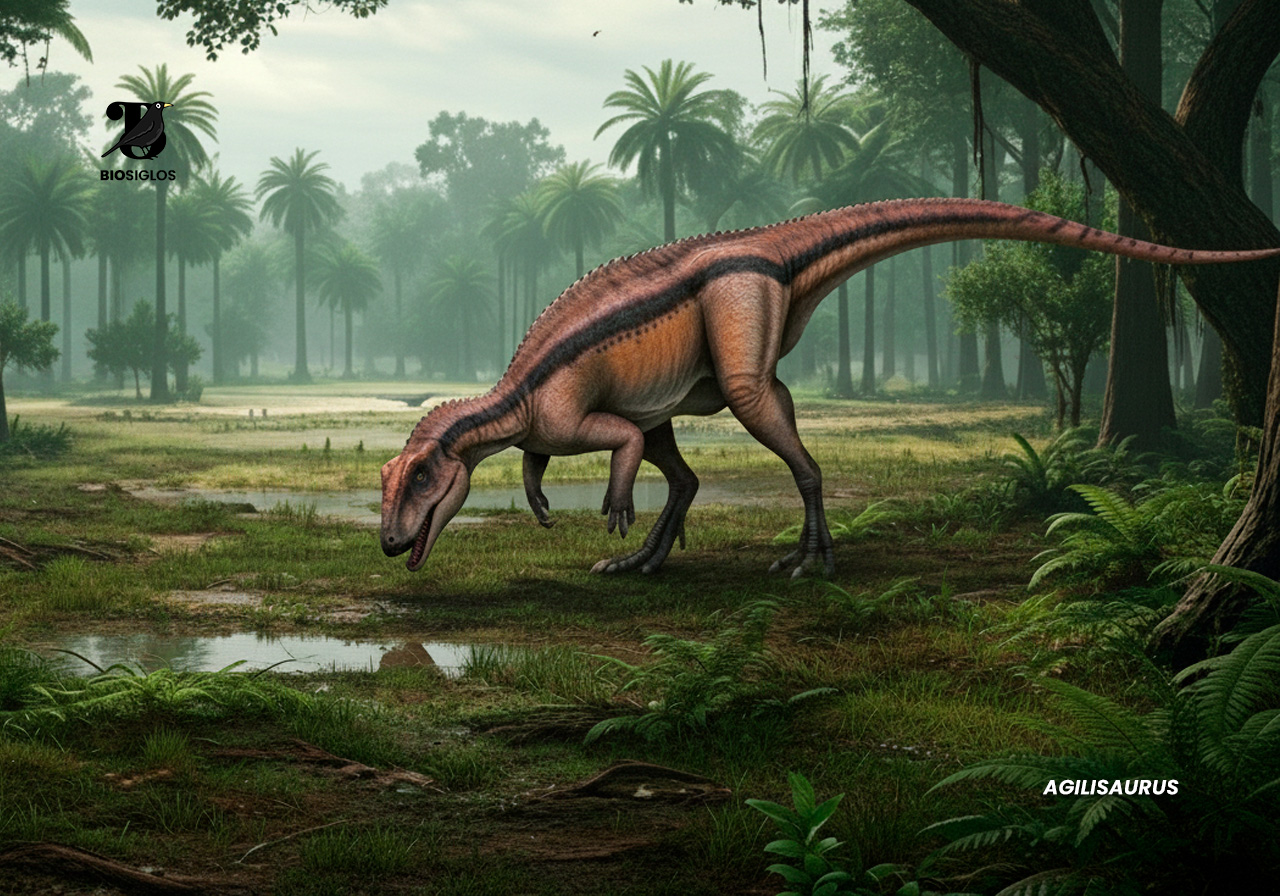
Agilisaurus
Agilisaurus was a small, herbivorous ornithopod dinosaur from the Middle Jurassic that lived in what is now China. It is one of the earliest known ornithopods and helps in understanding the evolution of bipedal running dinosaurs.
🦕 Basic Info
- Scientific and common name: Agilisaurus louderbacki – Agilisaurus
- Meaning of the name: “Agile lizard”
- Geological epoch or period: Middle Jurassic (~168 million years ago)
- Location of discovery: Sichuan Province, China
- Classification:
- Kingdom: Animalia
- Phylum: Chordata
- Class: Reptilia
- Order: Ornithischia
- Family: Agilisauridae
- Genus: Agilisaurus
- Diet: Herbivore
🧪 Main Characteristics
- Size: A small dinosaur, with a length of 1.2 to 1.8 meters.
- Locomotion: It was an exceptional bipedal runner. Its most notable feature was its tibia, which was significantly longer than the femur, a classic adaptation for achieving high speeds.
- Body: A very light and graceful build, with a long, stiff tail that acted as a rudder and counterbalance.
- Skull: It had a short, tall skull with large eye sockets, suggesting good vision. Its snout ended in a horny beak for cutting plants.
- Teeth: It possessed leaf-shaped teeth adapted for chewing fibrous, low-growing vegetation.
🌍 Environment in which it lived
- Habitat: A lush and humid floodplain with a vast system of rivers and lakes.
- Climate: The climate was warm, humid, and subtropical, with abundant rainfall.
- Ecosystem: It was part of the diverse “Shaximiao Fauna,” a Jurassic ecosystem in China famous for its incredible abundance and diversity of dinosaurs.
- Vegetation: It selectively fed on low-growing vegetation, such as ferns, cycads, and horsetails.
🧬 Evolutionary Transition
- Role: It represents one of the earliest and most basal forms of the clade Neornithischia, the group that includes the majority of ornithischian dinosaurs (such as ornithopods, ceratopsians, and pachycephalosaurs).
- Relationship: It is located at the base of the neornithischian family tree, near the divergence that gave rise to the great herbivorous lineages of the Jurassic and Cretaceous.
- Importance: Its complete skeleton and basal position make it a reference fossil for understanding the ancestral body plan from which ornithopods and other related groups evolved.
- Success: Its body design, focused on speed, represented a very successful survival strategy for small herbivores in a world dominated by giants.
🦴 Fossils Found
- Material: It is known from a nearly complete and articulated skeleton, including the skull.
- Discovery: It was discovered in the famous Dashanpu Quarry in Sichuan in 1984, during the construction of a dinosaur museum on the same site.
- Condition: The main specimen (holotype) is exceptionally well-preserved, making it one of the most complete small ornithischian dinosaurs in the world.
- Relevance: It is a reference fossil for paleontology, as its excellent state of preservation has allowed for a very detailed study of the anatomy of a primitive neornithischian.
👪 Relationship with other species
- Dinosaurs: It coexisted with the giant sauropods Omeisaurus, Shunosaurus, and Datousaurus, the primitive stegosaur Huayangosaurus, and the predator Gasosaurus. It also lived alongside large predators like Yangchuanosaurus.
- Reptiles: It shared the rivers and lakes with crocodiles like Hsisosuchus and various species of primitive turtles.
- Amphibians: The wet areas of the environment were inhabited by giant temnospondyl amphibians like Sinobrachyops and the first salamanders.
- Fish: The river systems were populated by bony fish and freshwater sharks like Hybodus.
- Mammals: It lived alongside small primitive mammals, such as the aquatic Castorocauda and the climbing Docodon.
- Birds: True birds did not exist, but the skies were dominated by pterosaurs (flying reptiles) like Angustinaripterus.