
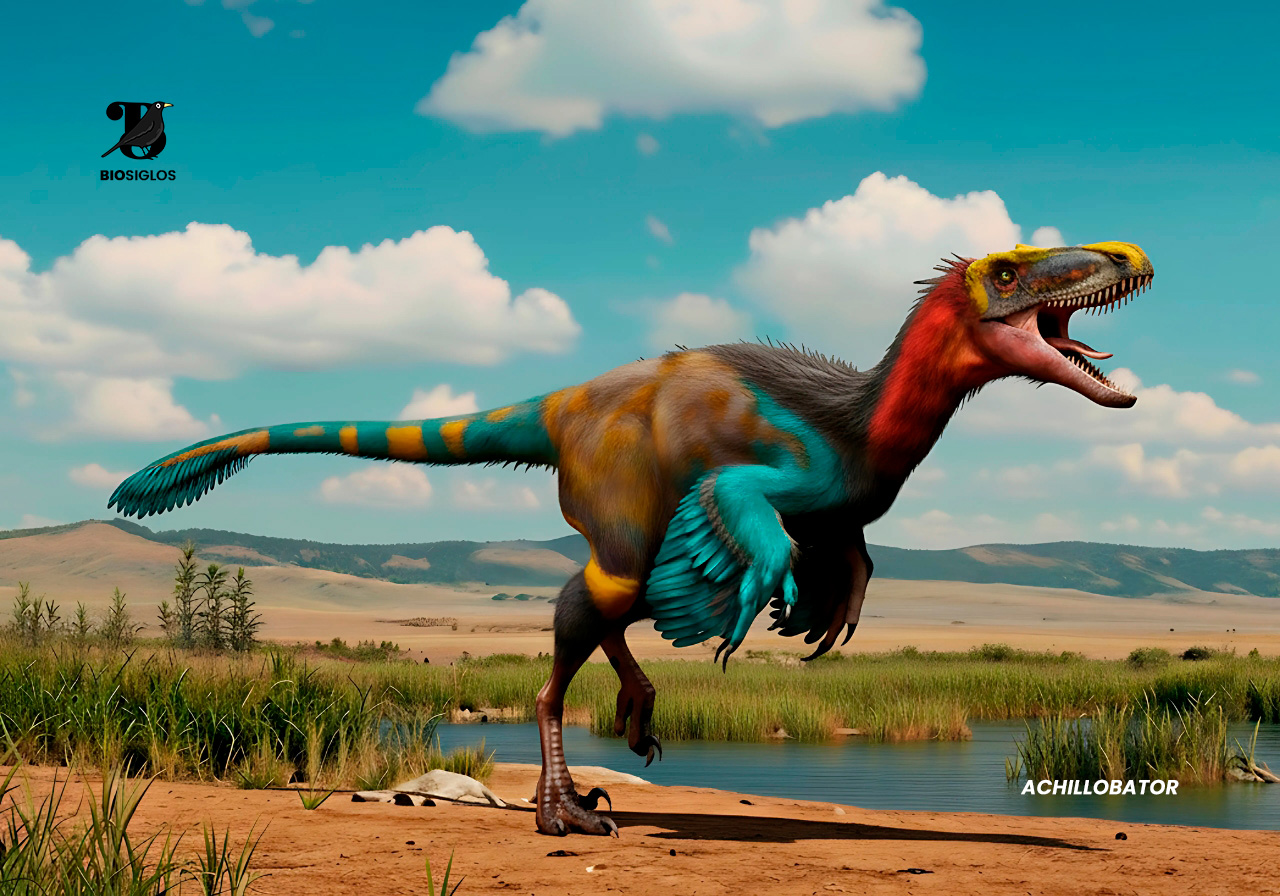
Achillobator
Achillobator was a carnivorous theropod dinosaur from the Late Cretaceous that inhabited Central Asia. It is one of the largest known dromaeosaurids. Its discovery helped redefine the size and predatory capabilities of the so-called “raptors.”
🦕 Basic Info
- Scientific name: Achillobator giganticus
- Common name: Achillobator
- Meaning of the name: “Giant hero,” in reference to Achilles and his strength (due to the slender heel on the discovered fossil)
- Period: Late Cretaceous (96 million years ago)
- Location of discovery: Mongolia (Bayan Shireh Formation)
- Classification:
- Kingdom: Animalia
- Phylum: Chordata
- Class: Reptilia
- Order: Saurischia
- Family: Dromaeosauridae
- Genus: Achillobator
- Diet: Carnivore
🧪 Main Characteristics
- Size: between 16 and 20 feet long
- Estimated weight: around 600–800 pounds
- Locomotion: bipedal, with strong and muscular hind legs
- Skull: long and narrow, with jaws equipped with sharp teeth
- Dentition: serrated teeth for tearing flesh
- Claw: large, curved, retractable claw on the second toe, typical of “raptors”
- Tail: stiff and long, used as a counterbalance and for balance while running or jumping
🌍 Environment it lived in
- Habitat: A semi-arid plain with seasonal river systems and vegetation concentrated along their banks.
- Climate: The climate was warm, with dry and wet seasons.
- Ecosystem: It was part of the diverse fauna of the Bayan Shireh Formation. It was one of the main predators in its ecosystem.
- Prey: It probably hunted medium-sized herbivorous dinosaurs, such as the hadrosaurs and ankylosaurs in its environment.
🧬 Evolutionary Transition
- Role: It represents one of the largest and most robust forms of the dromaeosaurid lineage.
- Relationship: It is a close relative of other giant “raptors” like Utahraptor and Dakotaraptor.
- Importance: Its discovery was key to demonstrating that “raptors” were not just small, agile predators, but that they also evolved into giant and heavily built forms.
- Unique anatomy: Its pelvis, with a vertically oriented pubis, is unusually primitive for a dromaeosaurid, which has generated debate about its exact position on the family tree and whether the original fossil could be a chimera (a mix of different animals).
🦴 Fossils Found
- Relevance: It is one of the most scientifically important giant dromaeosaurids, providing a crucial view of the diversity of sizes and forms within this iconic group of predators.
- Material: It is known from a single partial skeleton, which includes a maxilla, teeth, vertebrae, and bones from the limbs and pelvis.
- Discovery: It was discovered in 1989 by a Mongolian-Russian expedition, but was not formally described until 1999.
- Condition: The bones were found disarticulated but associated, which has allowed for a good reconstruction of its anatomy.
👪 Relationship with other dinosaurs
- Dinosaurs: It coexisted with the tyrannosauroid predator Alectrosaurus, the strange therizinosaurid Segnosaurus, and the armored ankylosaur Talarurus. It was a member of the Dromaeosauridae, a close relative of Utahraptor, Deinonychus, and Velociraptor.
- Reptiles: It shared its habitat with crocodiles like Shamosuchus and various species of turtles.
- Amphibians: Primitive amphibians inhabited the aquatic environments.
- Fish: The river systems were populated by bony fish, of which a fragmentary record exists.
- Mammals: It lived alongside small primitive mammals like Bayshinoryctes and Ravjaa.
- Birds: Birds have not been found in this formation, but the skies were dominated by large pterosaurs (flying reptiles) like Gobiazhdarcho and Tsogtopteryx.