
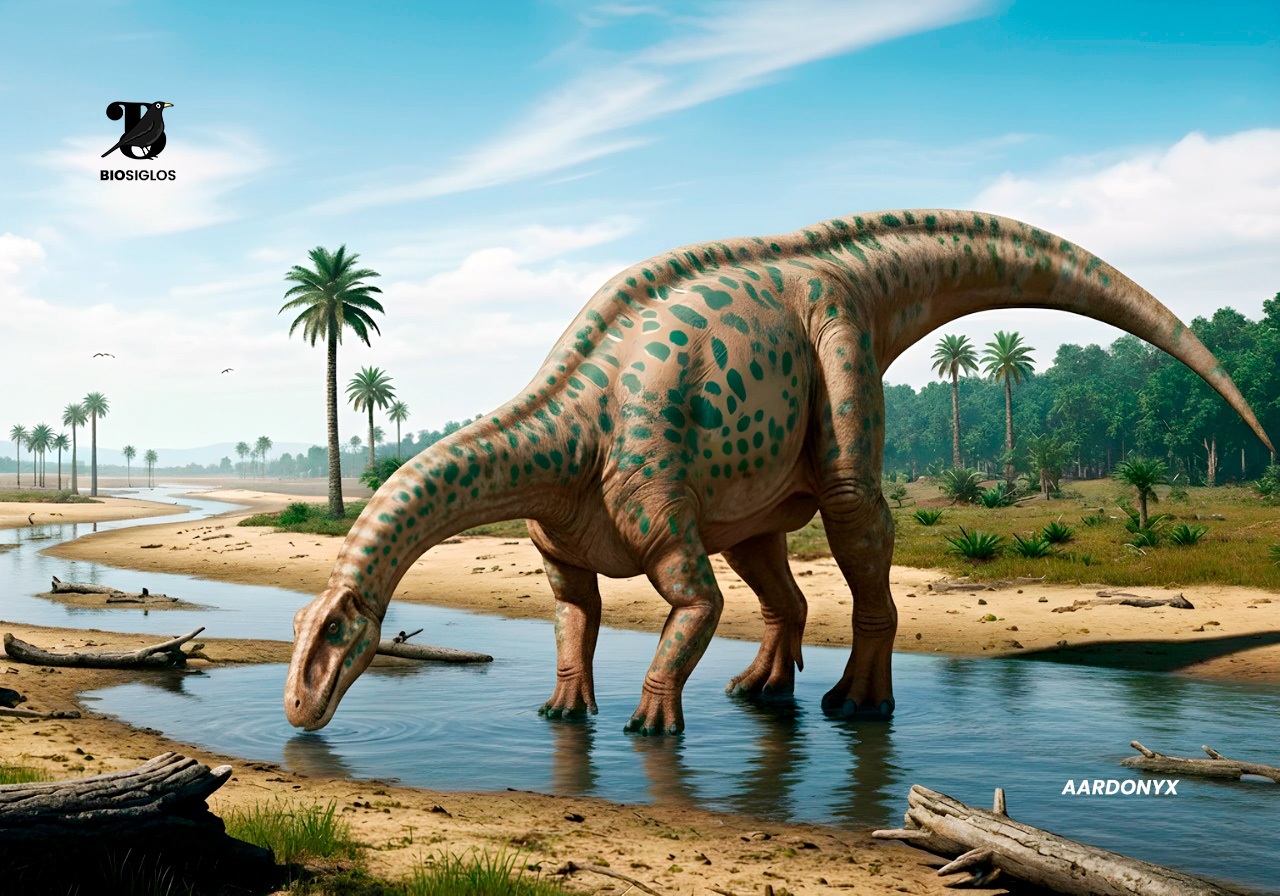
Aardonyx
Aardonyx was an herbivorous dinosaur from the Early Jurassic that lived in what is now South Africa. It is considered a crucial link in the evolution of giant sauropods, as it combines characteristics of both bipedal and quadrupedal dinosaurs.
🦕 Basic Info
- Scientific name: Aardonyx celestae
- Common name: Aardonyx
- Meaning of the name: “Earth claw” (from Afrikaans “aard” = earth, and Greek “onyx” = claw)
- Period: Early Jurassic (200 to 190 million years ago)
- Location of discovery: South Africa, Elliot Formation (Free State province)
- Classification:
- Kingdom: Animalia
- Phylum: Chordata
- Class: Reptilia
- Order: Saurischia
- Family: Anchisauria
- Genus: Aardonyx
- Diet: Herbivorous
🧪 Main Characteristics
- Size: About 20 to 23 feet long
- Weight: Between 1000 and 2000 lb
- Locomotion: Facultative biped (could walk on two or four legs)
- Skull: Small, with a light structure
- Dentition: Leaf-shaped teeth, typical of herbivores
- Limbs: Hands with large claws, long arms adapting to quadrupedalism
- Spinal column: Evidence of a horizontal posture evolving towards sauropods
🌍 Environment it lived in
- Habitat: A semi-arid plain with braided rivers and scattered oases.
- Climate: The climate was seasonal, with well-defined dry and rainy periods.
- Ecosystem: It inhabited a world recovering from the Triassic-Jurassic mass extinction. Herbivorous dinosaurs were beginning to reach large sizes for the first time.
- Vegetation: It fed on the available flora in its environment, such as ferns, cycads, and conifers.
🧬 Evolutionary Transition
- Role: It is a key transitional fossil that documents the origin of sauropods from prosauropod ancestors.
- Relationship: It is placed on the family tree right at the base of Sauropoda. It is more advanced than prosauropods like Massospondylus but more primitive than true sauropods like Vulcanodon.
- Importance: The anatomy of its limbs is fundamental to understanding how sauropodomorphs went from being agile, bipedal animals to giant quadrupeds that supported immense weight.
- Evolution: It shows how adaptations for gigantism (such as the thickening of leg bones) evolved gradually.
🦴 Fossils Found
- Relevance: It is a world-reference fossil for the study of macroevolution, showing in great detail the anatomical changes that allowed for one of the greatest milestones in the history of life: the emergence of the largest land animals of all time.
- Material: It is known from the disarticulated remains of two juvenile individuals, which together represent most of the skeleton.
- Discovery: It was discovered in the 2000s in South Africa and described by a team of paleontologists in 2009.
- Condition: Despite being disarticulated, the bones are well-preserved and have provided an immense amount of information about its biomechanics.
👪 Relationship with other species
- Birds: Birds did not exist. The skies were dominated by pterosaurs (flying reptiles) like Dimorphodon.
- Dinosaurs: It coexisted with the giant prosauropod Massospondylus, Melanorosaurus, and with primitive theropod predators like Dracovenator.
- Reptiles: It shared its habitat with primitive terrestrial crocodiles like Protosuchus and with the first types of turtles.
- Amphibians: Relict temnospondyl amphibians inhabited the aquatic environments.
- Fish: The river systems were populated by bony fish and lungfish.
- Mammals: It lived alongside the first true mammals, like the small insectivore Megazostrodon, and with other synapsids like the tritylodontids.
- It is also a basal member of the sauropodomorphs, the lineage that led to giant dinosaurs like Diplodocus, Apatosaurus, and Argentinosaurus.