
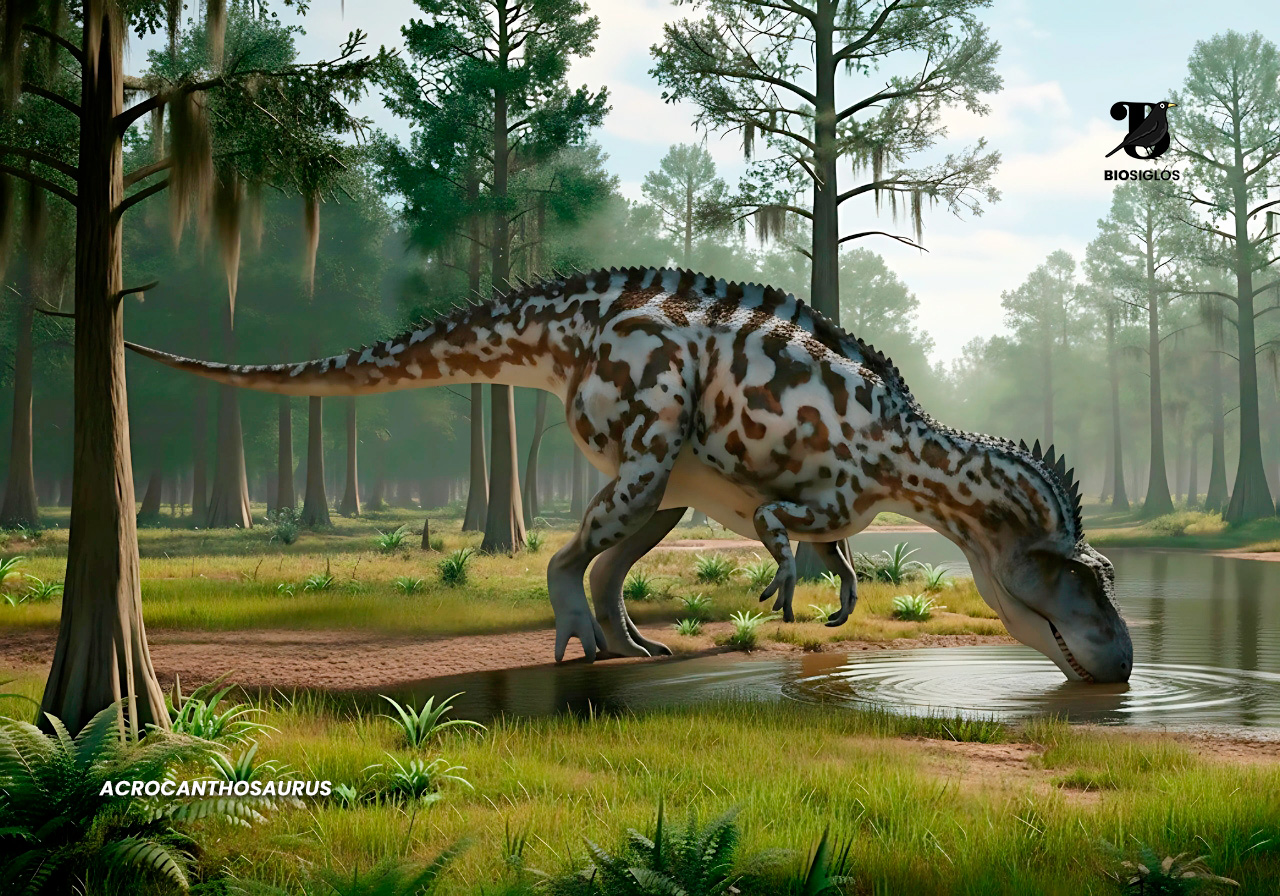
Acrocanthosaurus
Acrocanthosaurus was one of the large predatory theropod dinosaurs of the Early Cretaceous in North America. It is considered one of the largest carnivores of its time and a possible apex predator in its ecosystem.
🦕 Basic Info
- Scientific name: Acrocanthosaurus atokensis
- Common name: Acrocanthosaurus
- Meaning of the name: “High-spined lizard” (from the Greek akros = high, akantha = spine, sauros = lizard)
- Period: Early Cretaceous (~115 to 105 million years ago)
- Location of discovery: United States (Oklahoma, Texas, Utah, and possibly Maryland)
- Classification:
- Kingdom: Animalia
- Phylum: Chordata
- Class: Reptilia
- Order: Saurischia
- Family: Carcharodontosauridae
- Genus: Acrocanthosaurus
- Diet: Carnivore
🧪 Main Characteristics
- Size: up to 38 feet long
- Estimated weight: between 5 and 6 tons
- Locomotion: bipedal, with powerful hind legs
- Skull: elongated and robust, with large openings to reduce weight
- Dentition: large, curved, and serrated teeth, suitable for tearing flesh
- Spinal column: tall neural spines from the neck to the tail, forming a raised dorsal structure
- Arms: relatively short but strong, with three fingers with large claws
🌍 Environment in which it lived
- It inhabited what is now the southern and central United States, in a warm region with plains, rivers, and coastal areas.
- The Early Cretaceous environment included swamps, floodplains, and coniferous forests.
- It shared its habitat with large sauropods (Sauroposeidon), ornithopods, and other smaller theropods.
- It was likely one of the dominant predators of its ecosystem.
🧬 Evolutionary Transition
- It is a basal member of the carcharodontosaurids, a group that includes giants like Giganotosaurus and Carcharodontosaurus.
- It shows an evolution towards larger bodies and more elongated skulls than classic allosaurids.
- Its morphology indicates a specialized adaptation for hunting very large prey, such as sauropods.
🦴 Fossils Found
- The first remains were found in Oklahoma in the 1940s.
- Several partial skeletons and an almost complete skull have been found.
- Most come from the Antlers Formation (Oklahoma and Texas) and the Twin Mountains Formation.
- Footprints possibly attributed to this dinosaur have also been identified, which allows for estimating its locomotor behavior.
👪 Relationship with other dinosaurs
- Dinosaurs: It hunted herbivores such as the giant sauropod Sauroposeidon, the iguanodontid Tenontosaurus, and the armored nodosaurid Sauropelta. It was a member of the Carcharodontosauridae, related to Giganotosaurus, Mapusaurus, and Carcharodontosaurus.
- Reptiles: It shared its habitat with crocodiles like Goniopholis and turtles like Glyptops.
- Amphibians: In aquatic environments, amphibians such as the giant salamander Albanerpeton were found.
- Fish: The river systems were populated by bony fish and freshwater sharks like Hybodus.
- Mammals: It lived alongside a great diversity of primitive mammals, such as the triconodont Astroconodon and the multituberculate Cedaromys.
- Birds: Birds have not been found in this formation, but the skies were dominated by pterosaurs (flying reptiles) like Cedrodraco.