
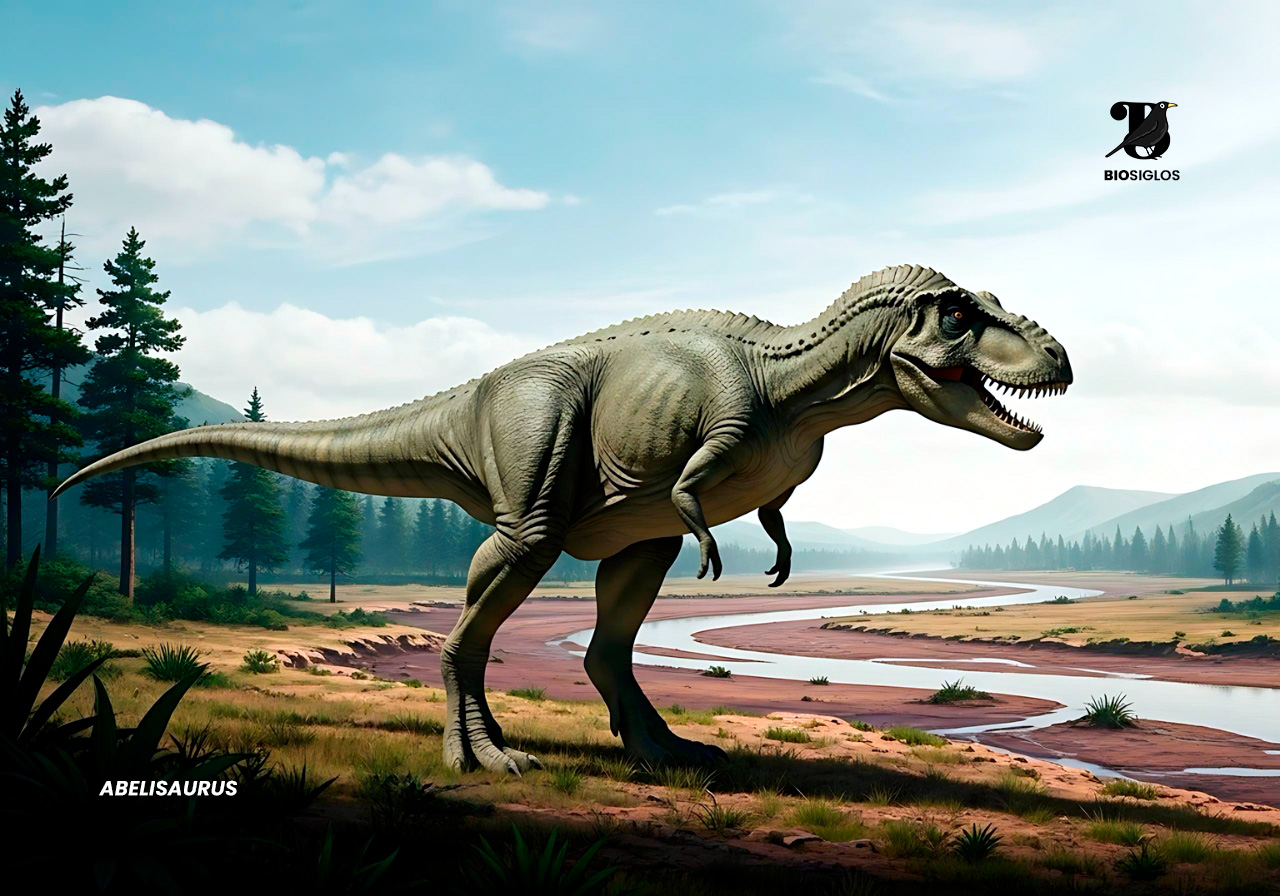
Abelisaurus
Abelisaurus was a carnivorous theropod dinosaur from the Late Cretaceous that inhabited what is now Argentina. It is a key piece for understanding the evolution of predators in the Southern Hemisphere.
🦕 Basic Info
- Scientific name: Abelisaurus comahuensis
- Common name: Abelisaurus
- Meaning of the name: “Abel’s lizard,” in honor of the Argentine paleontologist Roberto Abel
- Period: Late Cretaceous (Between 83 to 80 million years ago)
- Location of discovery: Argentina (Neuquén province, Patagonia)
- Classification:
- Kingdom: Animalia
- Phylum: Chordata
- Class: Reptilia
- Order: Saurischia
- Family: Abelisauridae
- Genus: Abelisaurus
- Diet: Carnivorous
🧪 Main Characteristics
- Estimated size: between 23 and 29 feet long
- Approximate weight: between 1.5 and 2 tons
- Locomotion: bipedal
- Skull: robust, with a short snout and powerful jaw
- Dentition: curved, sharp, and serrated teeth for tearing flesh
- Limbs: very short and not very functional front legs, similar to those of other abelisaurids
- Posture: body balanced on its strong hind legs, with a stiff tail for balance
🌍 Environment in which it lived
- Habitat: A semi-arid alluvial plain with a system of braided rivers.
- Climate: The climate was seasonal, with dry and wet periods.
- Ecosystem: It was one of the apex predators of its ecosystem. Its robust build made it ideal for hunting the titanosaurian sauropods that dominated the landscape.
- Prey: It hunted herbivorous dinosaurs such as titanosaurs and medium-sized ornithopods.
🧬 Evolutionary Transition
- Role: It is the member that gives its name to the family Abelisauridae and the clade Abelisauria, one of the most important and successful theropod radiations of Gondwana.
- Relationship: It is a close relative of other Southern Hemisphere predators such as Carnotaurus, Majungasaurus (from Madagascar), and Indosuchus (from India).
- Importance: Its discovery in 1985 was fundamental to recognizing and defining abelisaurids as a distinct group from the tyrannosaurids, which dominated the Northern Hemisphere.
- Evolution: It represents the typical body plan of abelisaurids: predators with short, tall skulls, tiny arms, and a robust build—an evolutionary solution very different from that of tyrannosaurs.
🦴 Fossils Found
- Material: It is known from a single specimen, which consists of an almost complete but fragmentary skull, missing the lower jaw.
- Discovery: It was discovered by the Argentine paleontologist Roberto Abel in 1983.
- Condition: Despite being only a skull, it is well-preserved enough to reveal the key features that define the entire Abelisauridae family.
- Relevance: It is a fossil of immense scientific importance. From this single skull, one of the most important families of carnivorous dinosaurs of the Cretaceous was defined.
👪 Relationship with other dinosaurs
- Dinosaurs: It coexisted with the abelisaurid predator Aucasaurus and with herbivores like the titanosaurian sauropod Neuquensaurus. It was a basal member of the Abelisauridae family, which includes more derived forms such as Carnotaurus, Majungasaurus, and Rajasaurus.
- Reptiles: It shared its habitat with terrestrial crocodiles like Neuquensuchus and primitive snakes like Dinilysia.
- Amphibians: Primitive frogs, such as those from the Calyptocephalellidae family, inhabited the humid areas of the environment.
- Fish: The rivers of the Anacleto Formation contained bony fish and lungfish.
- Mammals: Mammals were scarce and small in this ecosystem, represented by basal forms such as dryolestoids.
- Birds: Primitive birds such as Neuquenornis and Patagopteryx were found in the environment.